How Publishers Can Test Audio Advertising Revenue
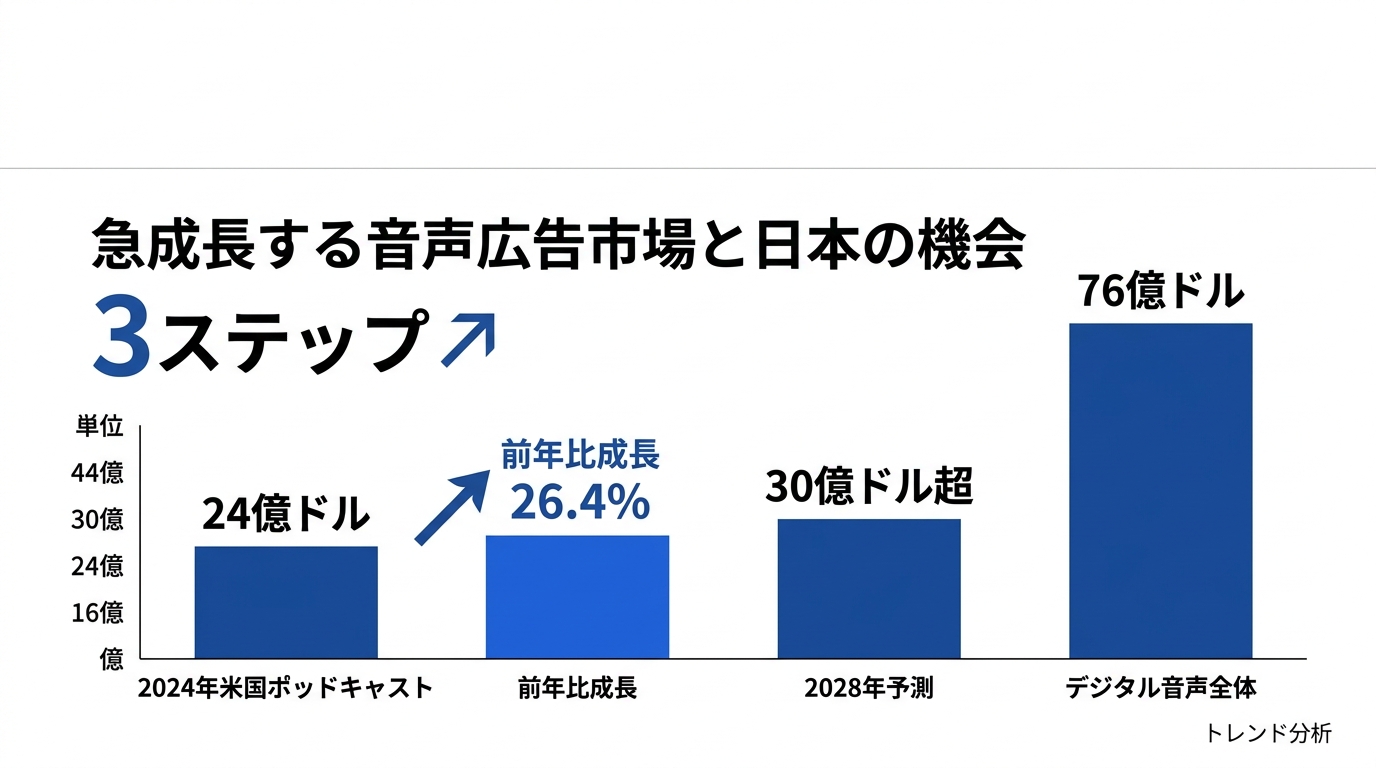
U.S. podcast advertising generated $2.4 billion in 2024. Public company results show the scale, but smaller publishers need a staged test rather than a copy of the American model.
By Yutaro Sasao, CEO of MediaLeap Inc. and a media monetization practitioner.
"How much can audio advertising actually make?"
I have heard that question from publisher business teams more than once. I spent close to a decade working across ad networks, SSPs, and a large publishing business, so I understand what sits behind it. Display yields are under pressure, while adding another banner often makes the reading experience worse.
The U.S. audio market offers evidence, but not a template that can be copied without adjustment. The IAB/PwC 2024 Internet Advertising Revenue Report recorded $2.4 billion in U.S. podcast advertising revenue, up 26.4% year over year. Digital audio advertising as a whole reached $7.6 billion.
Those are U.S. figures, shaped by a large English-language audience and a mature brand-advertising market. A regional publisher in Japan, Europe, or Southeast Asia starts from a very different position. The useful question is not, "How do we become iHeartMedia?" It is, "What is the smallest test that can tell us whether our readers will listen?"
Audio earns attention differently
Display advertising competes for a narrow area of the screen. During my years working with Google Ad Manager and programmatic inventory, advertisers repeatedly asked how to make users notice a placement. Rich media, interstitials, and native formats changed the presentation, but they did not remove banner blindness.
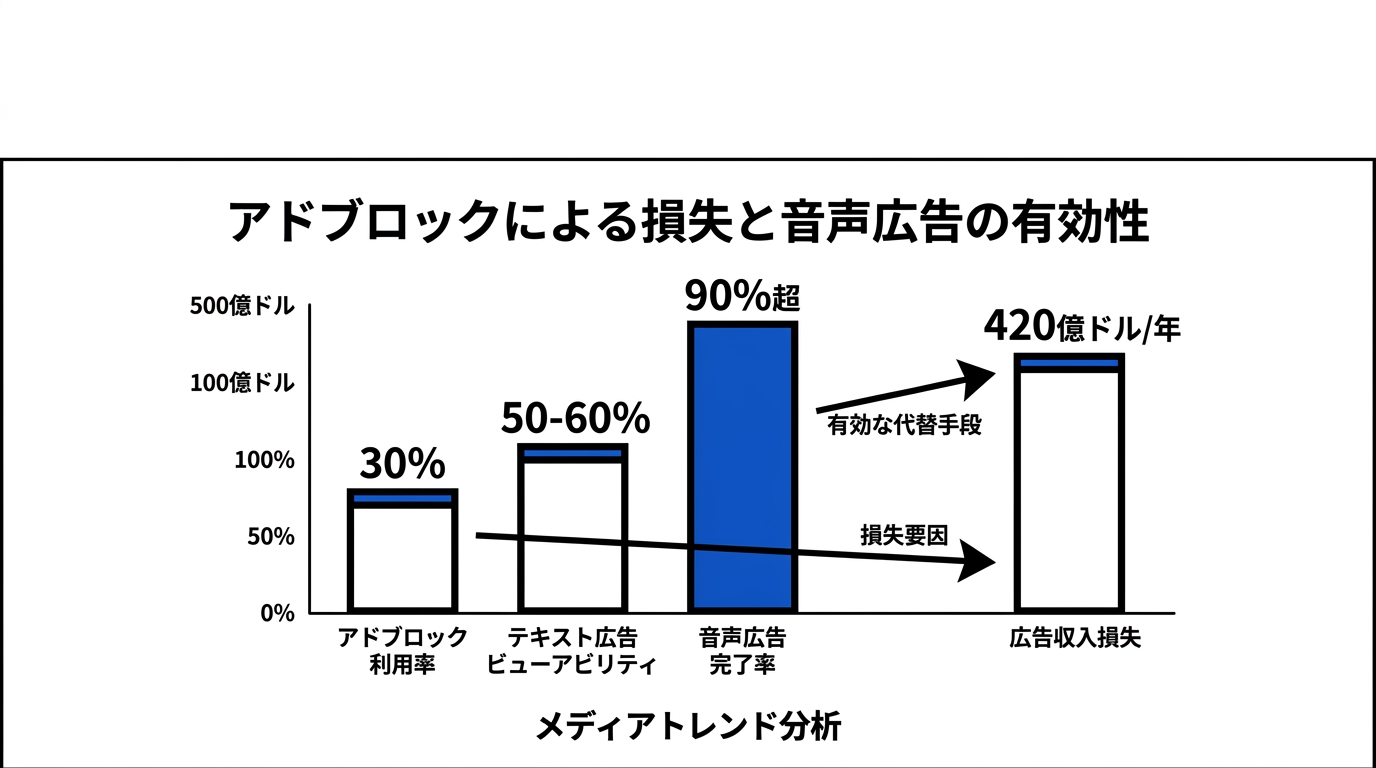
Audio enters the listening sequence instead. Industry benchmarks often report completion rates above 90%, although results vary by placement, length, and whether listeners can skip. A Scripps and Nielsen study reported podcast advertising recall as much as 4.4 times higher than other digital formats.
That advantage has a cost. A forced pre-roll can make a visitor abandon playback before the article begins. Audio is not inherently respectful; the product design determines whether it feels like part of the experience or an interruption.
<figure> <img src="https://images.media-leap.com/blog/2026/07/1784683073640-wtfsdgfb.png" alt="Comparison of visual display ads and audio ads in the content experience" /> <figcaption>Audio can hold central attention, but mandatory playback and long pre-rolls can also increase abandonment.</figcaption> </figure>Public company results show the ceiling
iHeartMedia reported $174 million in podcast revenue for the fourth quarter of 2025, up 24% year over year (iHeartMedia Q4 2025). SiriusXM reported 41% growth in podcast advertising revenue in 2025. Acast's fourth-quarter revenue rose 27%, and the company reached full-year profitability.
Podcast CPMs commonly range from $15 to $50, with host-read and specialized business shows sometimes priced higher. These are market ranges, not guaranteed rates. Audience quality, host trust, geography, and sales arrangements matter more than the audio file itself.
The lesson for publishers is structural: a listening session can create scarce, measurable inventory. The mistake would be treating every text article as premium podcast inventory from day one.
Programmatic buying lowered one barrier
Spotify launched Spotify Ad Exchange in April 2025 with integrations including The Trade Desk, Google DV360, and Amazon DSP (Spotify Newsroom). Audio placements can now enter buying workflows that advertisers already use for display and video.
Generative production tools lowered another barrier. Spotify's Gen AI Ads can produce scripts, narration, and background music for eligible advertisers in the United States and Canada. In Spotify's SHI International case study, the campaign drove three times the site traffic of a previous professionally narrated campaign. It is one advertiser case, not a general benchmark.
I have seen the same cost dynamic from the supply side. When creative production falls from a major project to a repeatable workflow, smaller advertisers can enter. More buyers can improve fill, but only after a publisher has enough listening volume to interest them.
A three-stage test for publishers
Build the listening habit before selling the interruption. Add audio to a small set of text-heavy evergreen articles. Do not begin with ads. Measure play rate, completion, engaged time, and return visits. The implementation sequence is covered in the five-step audio publishing guide.
Test short house messages. Once playback volume is stable, insert a five- to ten-second message before or after selected articles. A house campaign reveals abandonment and completion effects without promising performance to an external advertiser.
Only then evaluate direct sales or programmatic demand. A publisher needs consistent plays, a clear audience description, and reliable measurement. Personalization and real-time bidding are later-stage capabilities, not starting requirements.
Across more than 30 MediaLeap client properties observed in GA4 from 2024 to 2026, sessions that initiated audio showed roughly 1.5 to 2.5 times the average engagement time of non-playing sessions on comparable article sets. This is an observational comparison, not a randomized experiment; listeners may already be more interested. The full conditions and limitations are documented in the audio engagement measurement article.
The U.S. model is evidence, not an answer
Brand budgets, audience scale, and podcast familiarity differ sharply by country. Japanese publishers, for example, operate in a market where performance advertising has historically carried more weight. A small news site with short breaking stories may spend more on sales, review, and ad operations than it earns from audio.
Publishers should also compare audio against other ways to retain a direct relationship. AI answer interfaces are creating their own ad inventory, a shift examined in ChatGPT ads and publisher strategy. Email, membership, events, and direct traffic may deserve investment before audio.
I am building PUBVOICE because I want smaller publishers to be able to run this test without first building an audio CMS. That does not make audio suitable for every publication. Three good articles, one month of consistent measurement, and a willingness to stop can reveal more than a large launch plan.
PUBVOICE - Deliver your articles as audio
We built PUBVOICE so media operators can add a listening experience without extra workload. Register an RSS feed and every new article gets audio automatically.
Every time we hear editors worry that readers never finish their articles, we keep coming back to the same answer: audio reaches the moments text cannot - commutes, chores, workouts. PUBVOICE was born from that conviction.

Yutaro Sasao
We take each person's "I want to" and "I want to be able to" seriously, and use technology to make it happen. That is our mission.
Opening up new possibilities with digital technology. Drawing on roughly ten years in the advertising and media industries, Yutaro builds app development for web media companies with AI-driven efficiency.
Talk to us about your next project
Contact us about app development or other digital initiatives. We will review your requirements and recommend an approach suited to your business.
Related posts
Contact
Contact us to discuss app development for your media business. We will recommend an approach based on your requirements and commercial goals.
Contact Form
Send us your inquiry using the form below. We aim to respond within 24 hours.
Contact by Email
info@media-leap.com
We aim to respond within 24 hours
Business Hours
Weekdays: 9:00–18:00 JST
Weekends and public holidays: Closed