Four Audio Revenue Models for Digital Publishers
Publishers can monetize audio through existing ad lift, audio ads, membership, and external distribution with sponsors. Each model needs a different test.
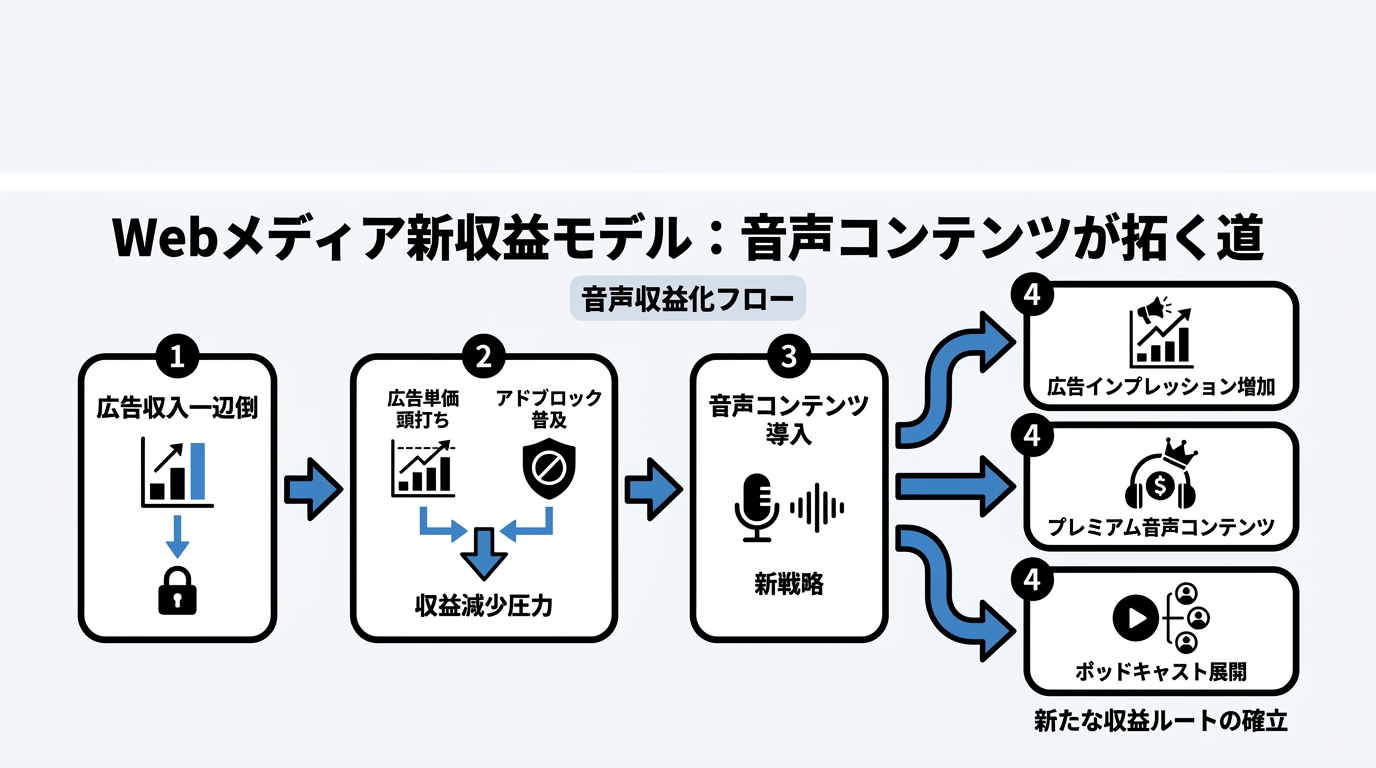
Editorial audio has four common revenue paths: indirect lift to existing advertising, audio advertising, paid membership, and external distribution with sponsorship. None is automatic, and each requires a different operating capability.
My background spans SSP monetization and analytics inside a large Japanese publishing organization. I have seen an extra ad unit lift one month’s revenue while weakening return behavior. Audio must be evaluated with revenue and audience metrics side by side.
1. Indirect display gains require controlled measurement
If listeners spend longer with a page or continue to another story, a publisher may create more opportunities for existing ads. The player alone does not cause that outcome.
An assumption such as “audio increases session time by 50%, leading to 20% more viewable impressions” is a scenario, not evidence. Background tabs can also inflate time metrics. Track starts, progress, completion, next-page activity, and ad impressions within comparable cohorts.
2. Audio ads create separate inventory
Pre-roll, mid-roll, and post-roll place a short commercial around editorial audio. Their revenue can be modeled as monetized plays multiplied by CPM and divided by 1,000.
The difficult inputs are monetized plays and price. Start rate, ad-load policy, fill, and listener drop-off all reduce the headline number. The audio ads revenue guide offers a staged test, while programmatic audio ad tech covers the additional burden of RTB.
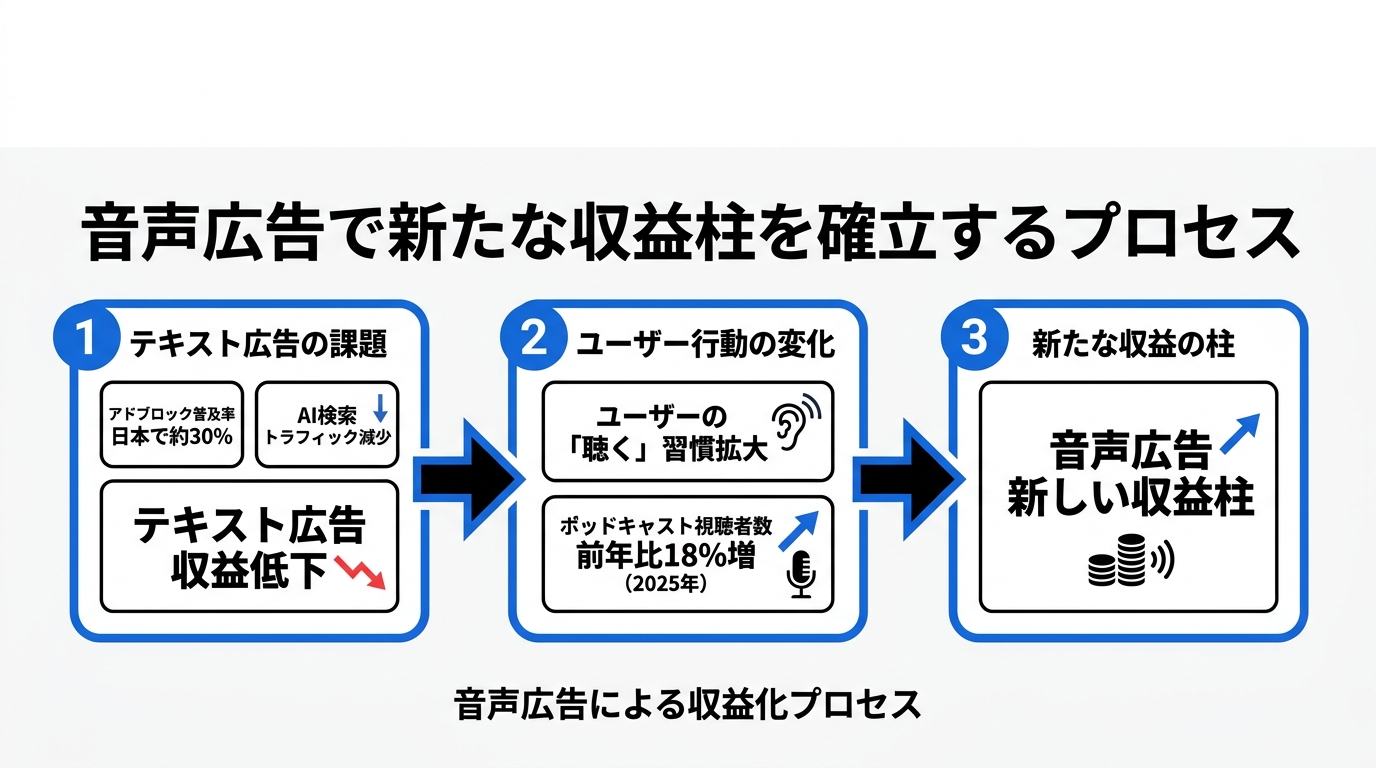
Ad-blocker use is estimated at about 30% globally in GWI data summarized by Backlinko. Audio is not a guaranteed workaround: dynamic ad requests can still be filtered. The ad-blocking analysis separates stitched and dynamically inserted delivery.
3. Membership turns audio into a reason to return
A publisher can include narrated articles, audio-only commentary, or an archive in a paid plan. This is less about charging for a file than giving members a useful format during commutes, exercise, or household work.
Consider a hypothetical $7 plan with 2,000 members: gross monthly revenue would be $14,000. That arithmetic is not a case study. Payment fees, churn, production, support, and taxes remain. Publishers should validate recurring listening before setting a price.
The audio subscriptions and retention guide compares long narrated editions, short daily briefings, and exclusive shows. Low publishing frequency is a structural weakness for this model.
4. External distribution opens sponsor inventory
Publishing article audio through Spotify, Apple Podcasts, or another listening platform can reach people who do not visit the website. Episode sponsorship, season sponsorship, and referral to the publisher’s own products become possible.
The trade-off is control. The platform owns much of the listening environment and limits first-party audience data. Referral traffic back to the site is not guaranteed. Site audio can deepen an existing relationship; external audio is better treated as audience acquisition.
Some publications should not add audio
Short alerts, formula-heavy reporting, visual investigations, and high-volume user-generated content often cost more to narrate and review than they can return. Specialist B2B readers may also prefer searchable text. Preference needs measurement, not assumption.
I have built products that worked technically and attracted little repeat use. That experience matters here. Shipping a player and creating a listening habit are separate jobs.
Begin with usage, not a revenue target
Add audio to ten popular evergreen or long-form stories. Run the test for two to four weeks without advertising. If starts and repeat listening appear, test one house ad, one member-only item, or one sponsored episode—not all three at once.
MediaLeap Inc. builds PUBVOICE to shorten the production and measurement work, but the ROI remains publication-specific. The first question is not which monetization model has the largest spreadsheet. It is which articles people choose to hear, and whether they come back.
PUBVOICE - Deliver your articles as audio
We built PUBVOICE so media operators can add a listening experience without extra workload. Register an RSS feed and every new article gets audio automatically.
Every time we hear editors worry that readers never finish their articles, we keep coming back to the same answer: audio reaches the moments text cannot - commutes, chores, workouts. PUBVOICE was born from that conviction.

Yutaro Sasao
We take each person's "I want to" and "I want to be able to" seriously, and use technology to make it happen. That is our mission.
Opening up new possibilities with digital technology. Drawing on roughly ten years in the advertising and media industries, Yutaro builds app development for web media companies with AI-driven efficiency.
Talk to us about your next project
Contact us about app development or other digital initiatives. We will review your requirements and recommend an approach suited to your business.
Related posts
Contact
Contact us to discuss app development for your media business. We will recommend an approach based on your requirements and commercial goals.
Contact Form
Send us your inquiry using the form below. We aim to respond within 24 hours.
Contact by Email
info@media-leap.com
We aim to respond within 24 hours
Business Hours
Weekdays: 9:00–18:00 JST
Weekends and public holidays: Closed