Article Audio Costs and ROI for Publishers
A transparent comparison of custom development and SaaS costs, with ROI scenarios driven by playback rate, ad delivery, and retention assumptions.
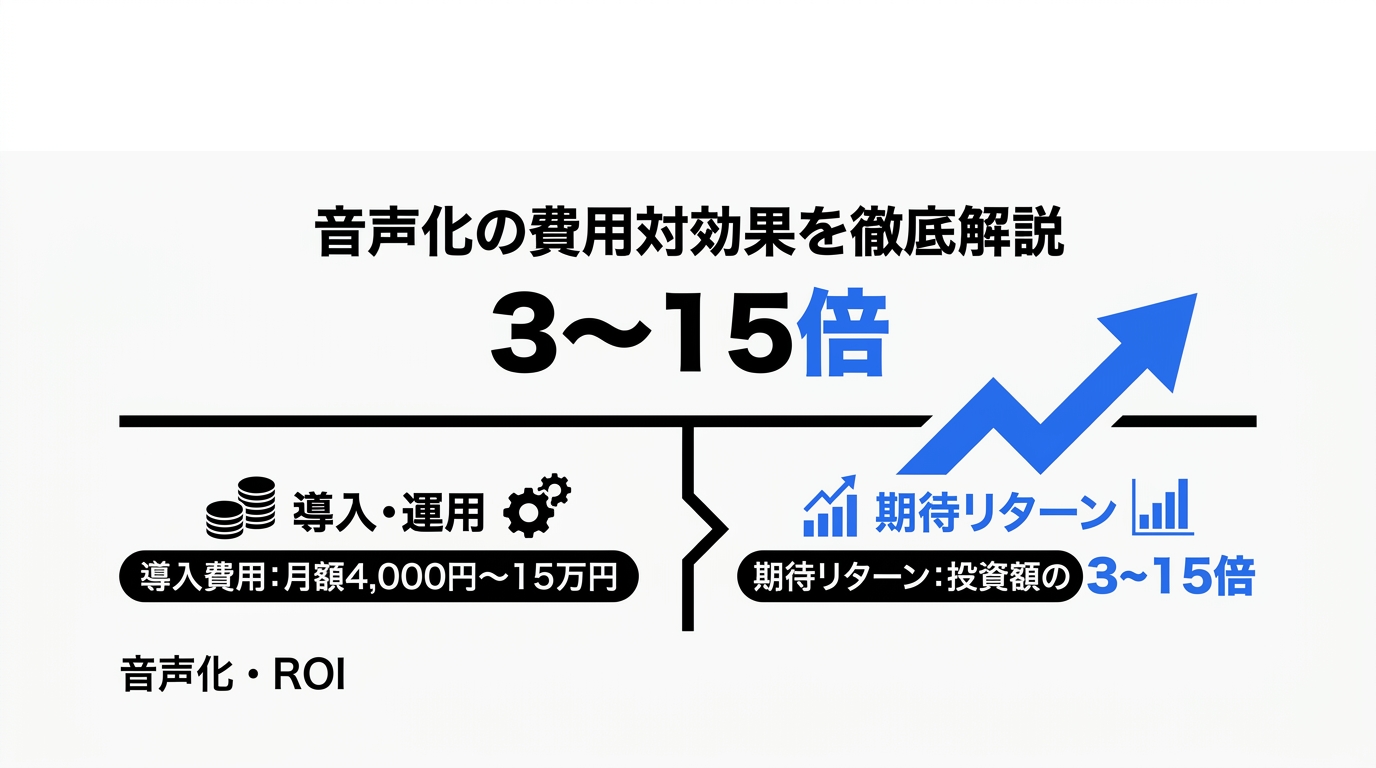
The cost of article audio is not the text-to-speech API bill. A publisher must also account for the player, delivery, pronunciation fixes, analytics events, and staff time.
I built a voice-chat application in roughly three months. Connecting text-to-speech took about two weeks; names, pauses, and long-form listening quality consumed more time. My earlier publisher analytics work also taught me not to price internal labor at zero.
Cost has three layers
A custom build includes API integration, player development, CDN delivery, CMS workflow, and measurement. In Japan, outsourced implementation often falls around ¥500,000–¥1.5 million, although the publishing stack and requirements can move that range considerably.
Ongoing work includes pronunciation dictionaries, generation failures, article updates, and support. SaaS reduces setup work but adds subscription limits and vendor dependency.
| Cost | Custom build | SaaS |
|---|---|---|
| Initial | About ¥500,000–¥1.5 million | ¥0 to tens of thousands |
| Monthly | TTS, CDN, and maintenance labor | About ¥3,000–¥100,000 |
| Launch time | Weeks to months | Days to weeks |
| Main burden | Engineering and maintenance | Contract limits and dependency |
Article volume and listening drive cost
A high-traffic site with a small audio catalog may spend less than a smaller site generating hundreds of short-lived stories. A directional monthly model is:
| Scale | New audio articles | Monthly estimate |
|---|---|---|
| Small | 20 | ¥4,000–¥15,000 |
| Medium | 100 | ¥15,000–¥60,000 |
| Large | 500 | ¥50,000–¥150,000+ |
Human review of every item, a custom player, long retention, or heavy delivery can push costs higher. Starting with proven long-form work tests demand while limiting spend.
ROI starts with playback rate
We have observed 1.5–2.5x longer engagement among listening sessions, but that figure cannot be applied to all pageviews. Our methodology article documents the conditions and limitations.
The following monthly scenario assumes a medium-sized Japanese publisher and a ¥30,000 SaaS cost. It is a model, not a recorded result.
| Scenario | Start rate | Display uplift | Audio ads | Membership | Total | ROI |
|---|---|---|---|---|---|---|
| Conservative | 3% | ¥20k | ¥10k | ¥0 | ¥30k | 1.0x |
| Base | 5% | ¥50k | ¥30k | ¥30k | ¥110k | 3.7x |
| High | 10% | ¥120k | ¥60k | ¥80k | ¥260k | 8.7x |
Display uplift assumes refresh and viewable inventory. Audio advertising depends on sell-through, ad load, fill, and listener drop-off. Membership uses a hypothetical ¥300 monthly contribution. Different inputs produce different outcomes.
From the ad-platform side, I saw high-CPM products fail when inventory did not sell. Audio is no exception. Starts, ad eligibility, and fill rate should come before a premium CPM narrative. Audio revenue and engagement separates the revenue paths.
Measurement needs a pre-launch baseline
Save engagement time, ad impressions, RPM, bounce behavior, and membership retention for eligible articles before launch. Afterward, compare listening and non-listening sessions on the same content. Because listeners may begin with higher intent, a randomized player-visibility test is stronger when feasible.
Average time alone hides where behavior changes. Track 25%, 50%, 75%, and completion events. Audio KPI measurement covers the event plan.
Some cases will not repay the investment
Short breaking items, visual stories, and pages used to retrieve one fact tend to receive fewer starts. Legal, medical, and tax publishing adds human-review cost. Even ¥30,000 per month is expensive if less than 1% of visitors listen.
MediaLeap Inc. operates PUBVOICE, a SaaS option for Japanese publishers. SaaS is useful for a reversible pilot; custom work can be better for extensive proprietary requirements. The 2026 publisher audio strategy places that choice in a rollout sequence.
Set the stopping rule before approving the spend. If starts, completion, and incremental value miss the threshold after four to eight weeks, do not expand the catalog.
Publishers modeling a low-setup Japanese pilot can review PUBVOICE.
PUBVOICE - Deliver your articles as audio
We built PUBVOICE so media operators can add a listening experience without extra workload. Register an RSS feed and every new article gets audio automatically.
Every time we hear editors worry that readers never finish their articles, we keep coming back to the same answer: audio reaches the moments text cannot - commutes, chores, workouts. PUBVOICE was born from that conviction.

Yutaro Sasao
We take each person's "I want to" and "I want to be able to" seriously, and use technology to make it happen. That is our mission.
Opening up new possibilities with digital technology. Drawing on roughly ten years in the advertising and media industries, Yutaro builds app development for web media companies with AI-driven efficiency.
Talk to us about your next project
Contact us about app development or other digital initiatives. We will review your requirements and recommend an approach suited to your business.
Related posts
Contact
Contact us to discuss app development for your media business. We will recommend an approach based on your requirements and commercial goals.
Contact Form
Send us your inquiry using the form below. We aim to respond within 24 hours.
Contact by Email
info@media-leap.com
We aim to respond within 24 hours
Business Hours
Weekdays: 9:00–18:00 JST
Weekends and public holidays: Closed