A 2026 Audio Strategy for Digital Publishers
A phased plan for publishers diversifying beyond display advertising, with transparent assumptions behind a ¥2–5.4 million annual revenue estimate.
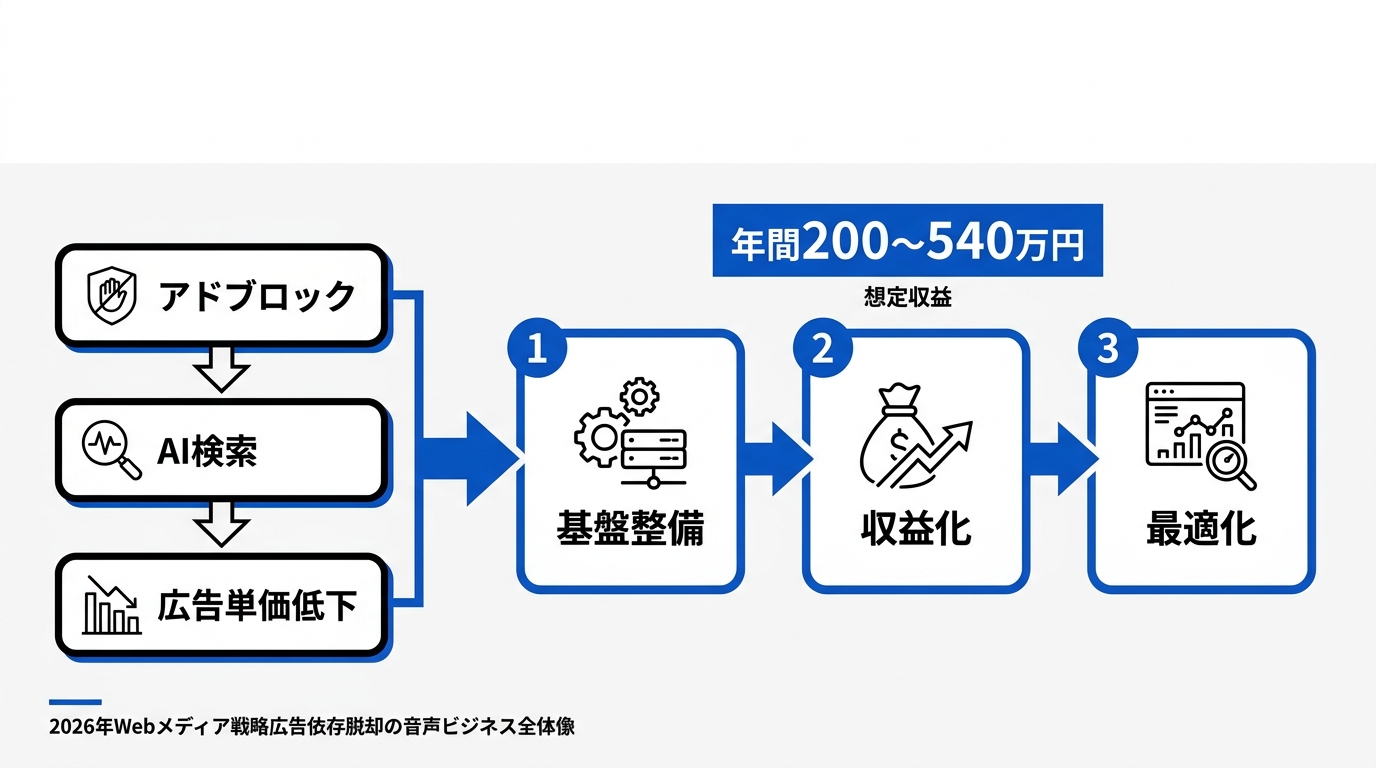
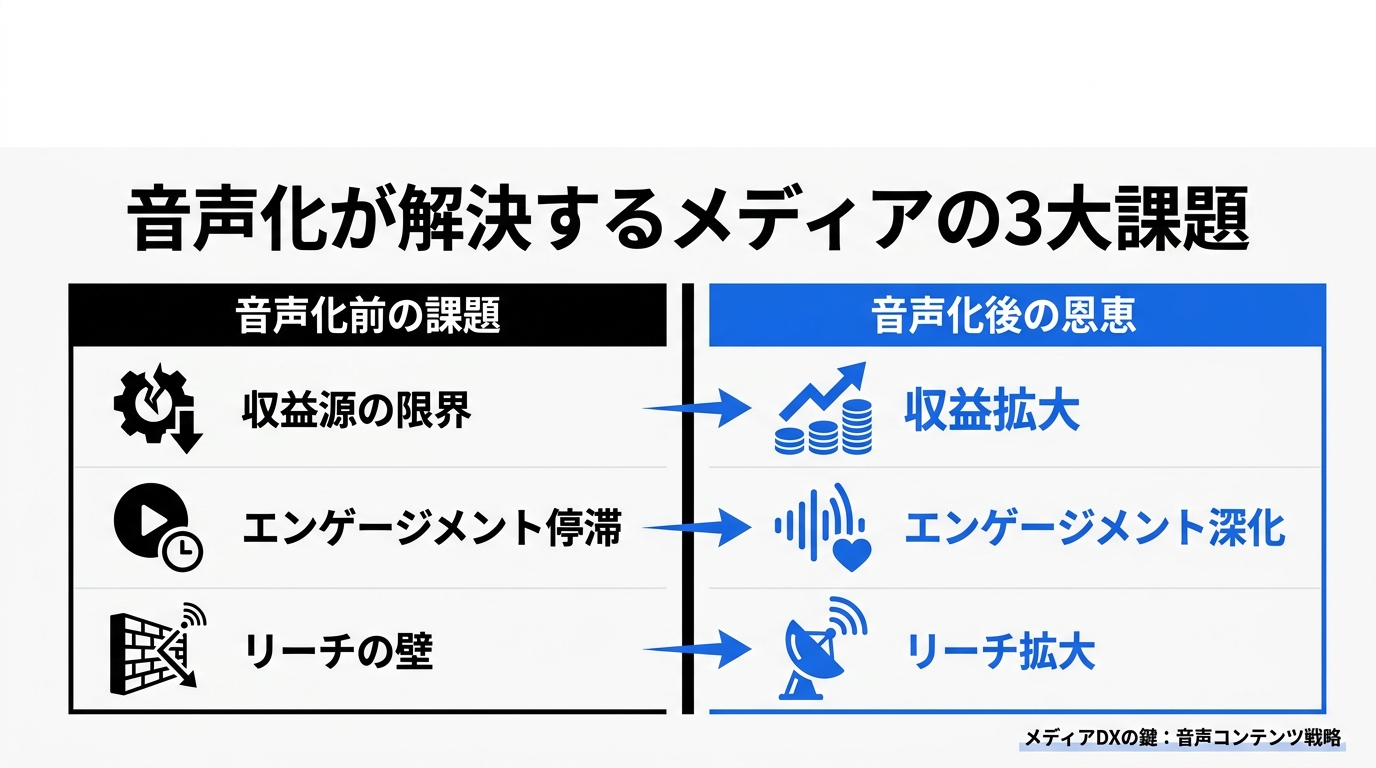
Digital publishers in 2026 face three overlapping pressures: blocked ad delivery, fewer search referrals, and lower yield on traffic that still arrives. Article audio will not replace advertising, but it creates separate tests for engagement, audio inventory, and subscriber retention.
I have worked on both the ad-tech and publisher sides of this equation. I have watched revenue weaken while rankings and pageviews looked stable. No single dashboard metric explains the business now.
Advertising is under pressure from several directions
For ad blocking in Japan, this article uses a single 15–17% range based on Backlinko’s compilation of GWI and related data. Survey method and device mix matter, so it should not be treated as a permanent national constant.
During my SSP and ad-network work, publishers tested detection, native formats, and richer units. None removed the underlying problem. Audio ads are not immune either; blockers can stop the ad request itself.
AI answer products can also satisfy part of a query without a click, while supply growth and identity restrictions affect display pricing. Revenue diversification beyond display examines the broader mix.
Audio is a diversification layer, not an ad replacement
Article audio can support existing display revenue through longer sessions, create audio inventory, or strengthen an existing membership. Publishers do not need to launch all three at once.
We have observed 1.5–2.5x longer engagement among listening sessions, but that does not apply to all visitors. Our methodology note explains the comparison and self-selection caveat.
From my analytics work at a large publishing site, I learned that asking a new feature to generate revenue in month one obscures the signal. If ads are inserted before listener demand is measured, a publisher cannot tell whether people rejected the audio or the ad load.
Split the year into validation, monetization, and refinement
In months 1–2, add audio to roughly 20 established long-form articles. Track start rate, playback milestones, completion, and engagement time for listening and non-listening sessions.
In months 3–6, test house promotions or a short pre-roll only on articles with repeat listening. Existing membership businesses can test audio as a retention benefit before creating a new paid tier.
In months 7–12, narrow production by topic, time, and device. If starts remain weak, do not move into an app or full-catalog production. Audio revenue and engagement covers the commercial paths.
The ¥2–5.4 million figure is an estimate
This is a planning scenario for a Japanese publisher with three million monthly pageviews, not a recorded result or promise.
| Input | Assumption |
|---|---|
| Monthly traffic | 3 million pageviews |
| Audio start rate | 5–10% target range |
| Display uplift | ¥100,000–¥200,000 per month |
| Audio advertising | ¥50,000–¥100,000 per month, dependent on sell-through and CPM |
| Membership effect | Measured separately, not guaranteed in the total |
| Annual incremental revenue | Approximately ¥2–5.4 million, including ramp-up |
| Annual cost | SaaS from ¥360,000; custom work adds ¥500,000–¥1.5 million upfront |
The upper case assumes rapid listener adoption and ad sales. A 3% start rate, unsold inventory, or no refresh uplift can push the result below the range and produce a loss. Audio publishing costs and ROI provides scenario math.
Some publications should skip audio
High-volume breaking news, visual explainers, and legal or medical reference pages can cost more to produce and review than they return. Interviews, columns, and contextual analysis are better initial candidates. Audio strategies at major news publishers compares production models.
MediaLeap Inc. operates PUBVOICE for Japanese publishers, which gives us a commercial interest in this category. The defensible approach is still to establish a baseline, test a limited set, and expand only when the publication’s own data supports it.
Publishers preparing a Japanese-language pilot can review PUBVOICE.
PUBVOICE - Deliver your articles as audio
We built PUBVOICE so media operators can add a listening experience without extra workload. Register an RSS feed and every new article gets audio automatically.
Every time we hear editors worry that readers never finish their articles, we keep coming back to the same answer: audio reaches the moments text cannot - commutes, chores, workouts. PUBVOICE was born from that conviction.

Yutaro Sasao
We take each person's "I want to" and "I want to be able to" seriously, and use technology to make it happen. That is our mission.
Opening up new possibilities with digital technology. Drawing on roughly ten years in the advertising and media industries, Yutaro builds app development for web media companies with AI-driven efficiency.
Talk to us about your next project
Contact us about app development or other digital initiatives. We will review your requirements and recommend an approach suited to your business.
Related posts
Contact
Contact us to discuss app development for your media business. We will recommend an approach based on your requirements and commercial goals.
Contact Form
Send us your inquiry using the form below. We aim to respond within 24 hours.
Contact by Email
info@media-leap.com
We aim to respond within 24 hours
Business Hours
Weekdays: 9:00–18:00 JST
Weekends and public holidays: Closed